The Seventh Flame: The Secret War That Created Earth
An original fantasy and science-fiction creation myth featuring gods, angels, demons, and an ancient civilization from the stars.
Before Earth had a name, before the first ocean found its shore, and before the stars learned to burn, there was a silence so complete that even eternity had nothing to measure.
Then something in the darkness began to cry.
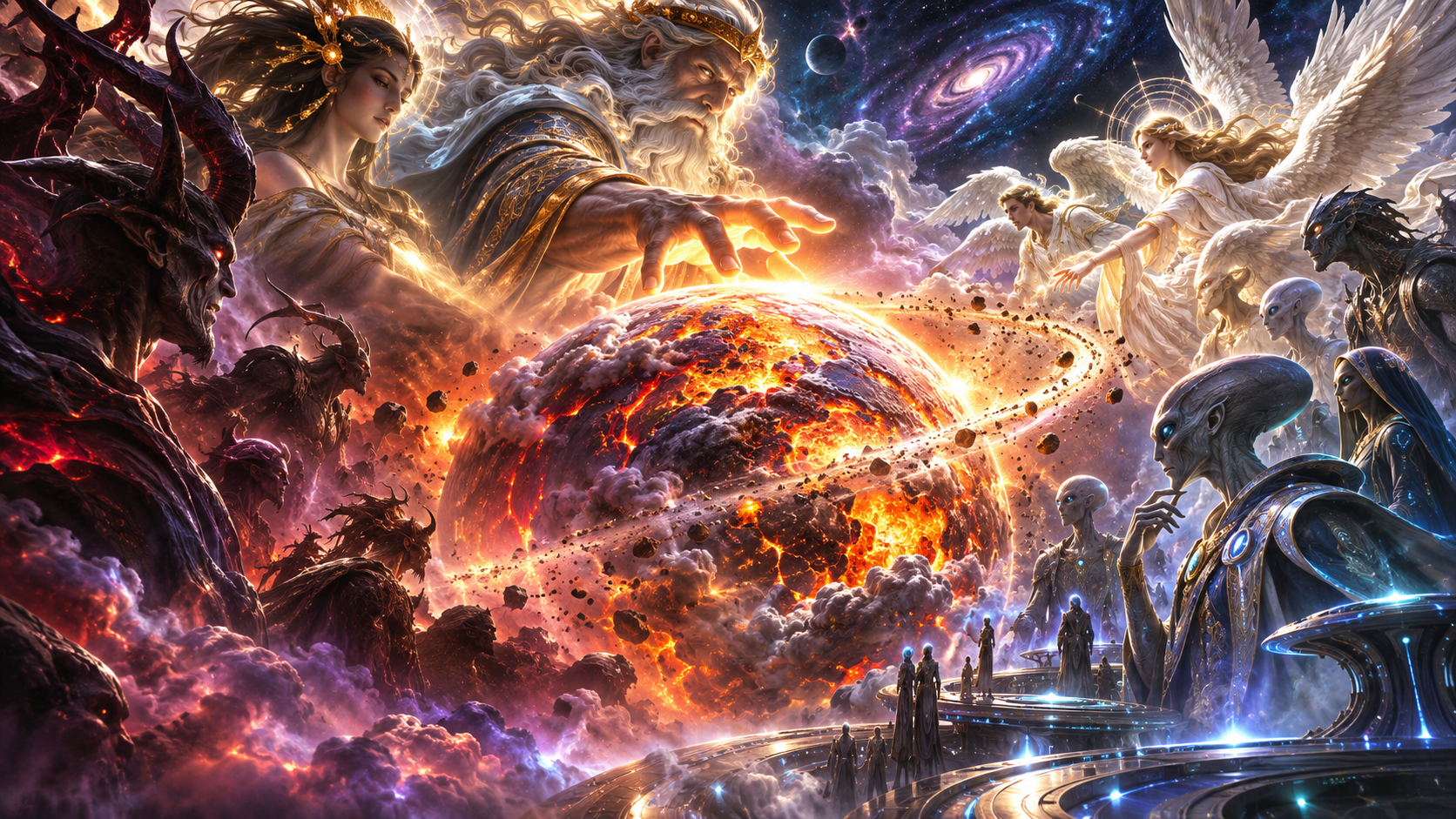
The sound was small, scarcely more than a trembling note, but it traveled across the emptiness and awakened four powers that had never before needed one another: the gods who governed existence, the angels who guarded its laws, the demons who remembered everything existence had destroyed, and the star-travelers who believed every mystery could be solved.
They followed the crying to a dying star.
Inside it, something impossible was waiting.
It was not a treasure, or a weapon, or a king. It was a world that had not yet been born, dreaming of the creatures who might one day call it home.
And all four powers wanted to decide what that world would become.

The four powers gather around the newborn world.
I. The Star That Refused to Die
In the earliest age, creation belonged to the High Court of Auralis. Its gods set galaxies turning and gave every star a lifespan, every orbit a path, and every ending a purpose.
Their ruler was Tharos, the Lord of Measure, whose crown was forged from the first ring of light. He could see every consequence of every action, provided that action obeyed the laws he had written.
Beside him stood Naira, the youngest of the gods, keeper of possibilities. She had no crown. Instead, she carried an empty bowl, for she believed the most precious things in creation were those that had yet to take shape.
Tharos considered this belief dangerous.
“An unfinished thing is an invitation to disorder,” he often told her.
“Or an invitation to wonder,” Naira replied.
Beyond their court flew the angels, vast and luminous beings whose wings were etched with the geometry of the heavens. Their commander, Seriel, could hear a broken promise from a thousand light-years away. They guarded the boundaries between worlds and carried dying suns into the Great Archive.
Beneath those shining realms lived the demons of the Cinder Deep. They had once been guardians too, but they chose to preserve what the gods wished forgotten: the ashes of failed worlds, the names of vanished civilizations, and the grief left behind by necessary endings. Their king, Vael, wore no horns of gold. His were blackened remnants of a star that had collapsed in his hands.
The demons were feared because they spoke of loss where the gods preferred order.
Farther away still, across the cold between galaxies, traveled the Aethari. They were neither divine nor infernal. They had learned to fold distance, speak through light, and store civilizations inside living crystals.
One such ship, the Pilgrim of Glass, detected a star that should already have died.
Its captain, Ilyr, watched the impossible signal repeat across his instruments. It was not merely radiation. It had rhythm. Intervals. A pattern resembling a heartbeat.
Then the ship’s translation engine produced four words:
PLEASE DO NOT FORGET.
II. The Council Beyond the Sun
Ilyr followed the signal into a nebula made of the remnants of ancient suns. At its center floated a bright, fractured sphere, no larger than a city, wrapped in streams of dust and burning metal.
When the Pilgrim of Glass approached, the sphere opened like an eye.
Ilyr saw unborn oceans, impossible trees, and countless faces that did not yet exist. The vision vanished.
He sent a call across every frequency his people knew.
The call reached Naira first. She came alone and recognized the sphere immediately. It was the Heart of Orun, the final remnant of a universe that had existed before the present one. That older universe had collapsed into darkness, but its last living minds had united in a desperate wish: let something remember us.
Their wish had survived as a spark.
Naira wanted to shelter it. Tharos wanted it destroyed.
“A memory from outside our laws cannot remain,” he declared when the High Court assembled above the dead star. “We do not know what it will become.”
“That is precisely why it deserves to live,” said Naira.
Seriel and the angelic hosts arrived in columns of white fire. Vael emerged from a rent in the darkness with twelve demons carrying urns of cold ash. Ilyr came with the small delegation of Aethari scientists who had first heard the heart’s plea.
For the first time, gods, angels, demons, and aliens stood together without a battlefield between them.
Naira offered a proposal: build a world around the surviving heart. Give it stone, water, air, and time. Allow the possibilities inside it to become real.
Tharos demanded guarantees. The angels wanted laws strong enough to keep the world from tearing itself apart. The Aethari wanted to study it. Vael wanted a place where endings would not be treated as shameful mistakes.
At last Tharos agreed, but only under one condition: the new world would be watched. If it developed a power capable of threatening the cosmic order, the gods would unmake it.
Naira lowered her empty bowl beneath the Heart of Orun.
“What shall we call it?” Ilyr asked.
“Not yet,” she said. “A name should be earned.”
And so began the most secret act of creation in the universe.
III. The Forging of the Blue World
First came the stone.
Tharos summoned wandering mountains from the wreckage of stars. Iron gathered around nickel; dust clung to dust; shattered rocks collided and fused. The growing sphere became a furnace, red as an open wound. Continents had not yet formed. There were only seas of molten rock and storms of falling debris.
The gods called it a successful beginning.
The demons called it unfinished.
Vael descended through the fire and placed his palms against the newborn crust. He gave the planet an inner hunger: heat that would rise, break mountains, reshape valleys, and move the ground beneath the feet of creatures not yet born.
“Your world will never hold still,” Tharos warned Naira.
“It will never stop becoming,” she answered.
Then the angels entered the storm. They wrapped the sphere in unseen currents, stitched a protective veil around its skies, and taught its turning heart to hold north and south. Seriel spread his wings across the burning surface, shaping winds that would one day carry rain, pollen, and human voices.
The Aethari brought machines woven from gravity. They steered streams of ice and mineral-rich debris toward the young planet, delivering the raw ingredients of oceans. For ages, their ships balanced heat, air, and water.
Still the world would not settle.
Orun’s heart was dreaming too loudly.
Dreams altered its mountains and seas. The sky flashed with unknown futures. The planet could not distinguish memory from possibility.
Ilyr discovered the problem. The heart had no rhythm outside itself. It needed a companion to pull against it, something that would keep its dreams from swallowing its days.
Tharos refused to sacrifice another star. Seriel offered his sword, but angelic weapons carried laws too rigid for the task.
Vael made a different suggestion.
“Break something beautiful,” he said. “Let the wound become an anchor.”
Before anyone could stop her, Naira took the silver shield she had carried since the dawn of creation and cast it into the path of a wandering world. The impact shattered her shield, struck the young planet, and threw a crown of luminous debris into the heavens.
But under the patient guidance of the Aethari, the debris gathered into a pale companion. It circled the planet, pulling at the newborn seas and slowing its wild rotation.
That companion became the Moon.
When its first light fell upon the cooling stone, the Heart of Orun finally fell quiet.
The world slept.

From fire and storms, the living Earth begins to take shape.
IV. The Rain of a Million Years
The first rain lasted longer than any kingdom would ever endure.
Water fell onto rock, became steam, and fell again. Rivers carved the newborn stone, and oceans filled the planet’s scars. The Moon drew their waters back and forth like a giant breathing in sleep.
Naira watched from a cliff of cooling basalt. Beside her stood Seriel, his wings darkened by ash.
“It is beautiful,” she said.
“It is violent,” the angel replied.
“Both things may be true.”
Deep beneath the waves, Vael opened the first furnace vents. There, minerals mingled with heat and water. The demons knew beginnings needed darkness.
The Aethari watched from stations beneath the seabed. Ilyr admired the planet’s patience. Its greatest work was invisible.
One day, a tiny membrane formed around a gathering of restless molecules.
It held together.
It divided.
It began again.
No trumpet sounded. No star changed course. Yet every instrument aboard the Pilgrim of Glass registered the same strange event: the Heart of Orun had answered a new heartbeat with its own.
Naira knelt by the sea and wept.
“You are crying for something too small to see,” Tharos said when he arrived.
“I am crying,” she answered, “because it is no longer only our creation.”
The gods had fashioned the conditions, the angels had guarded them, the demons had given the depths their fire, and the aliens had brought the elements together. Yet none of them had commanded this tiny life to want tomorrow.
That desire belonged to the world itself.
Tharos examined the little creature and found nothing threatening. He permitted it to continue.
Vael, however, smiled at the decision. He understood what the others had missed. Anything that wanted to live would someday fear dying. And anything that feared dying might one day challenge a god.
The first life spread into millions of forms. For an age beyond counting, Earth belonged to creatures without eyes, then to creatures with shells, then to swimmers, crawlers, and hunters. Forests rose, fell, and rose again. Giants walked beneath strange skies, and whole lineages vanished when the planet changed its mind.
Each extinction disturbed Naira.
Vael would sit beside her through the long silences.
“Nothing that lived is erased,” he told her. “Not while something remembers.”
He opened one of his urns and showed her its contents: the shining memories of every creature the world had lost.
For the first time, Naira understood why the demons had kept the ashes.
V. The Garden Beneath the Stars
As Earth grew rich with life, the Aethari began to envy it.
Their home civilization was old and extraordinarily clever, but its people had removed unpredictability from nearly every corner of existence. Their children were designed, their forests regimented, and their oceans silent.
On Earth, by contrast, nothing obeyed a final design.
Ilyr watched a tree grow around a fallen stone rather than surrender to it. He watched creatures cooperate with rivals, and tiny flowers appear in cracks made by earthquakes. He became convinced that life’s most astonishing invention was not survival, but improvisation.
He named the planet Eara, an Aethari word meaning the answer that changes the question.
Over countless ages, his people visited the world in secret. Sometimes they planted harmless fragments of distant biology to see whether they would take root. Usually they observed, knowing interference could destroy surprise.
The angels noticed their visits and objected.
“This world is not your laboratory,” Seriel warned.
“Nor is it your temple,” Ilyr replied. “It belongs to what lives here.”
Naira sided with the star-traveler. Tharos did not.
The Lord of Measure had been watching something troubling emerge among Earth’s creatures: intelligence that could imagine what did not yet exist. It appeared in tools, games, and tenderness. As minds became more complex, Orun’s heart grew brighter beneath the crust.
Soon, Tharos believed, a species might become capable of hearing the heart’s ancient wish.
He called another council.
“Let us guide the next great species,” he proposed. “Let it be wise enough to understand the world, but obedient enough never to endanger it.”
Seriel supported guidance. Ilyr proposed teaching knowledge and allowing the creatures to decide how to use it. Vael demanded that they be allowed to fail.
Tharos dismissed that idea.
“Failure causes suffering.”
“And obedience without choice,” Vael replied, “is merely a beautiful cage.”
Their disagreement hardened into factions. Angels increased their patrols, aliens withdrew behind the Moon, and demons hid beneath mountains.
Naira stood alone between them, looking down at a green and blue world that was becoming more beautiful than any of them had planned.
She feared its creators were preparing to destroy it in the name of protection.
VI. The First People and the Gift of Fire
At last there came a morning when a young human stood on a high ridge and watched the sunrise without thinking only of food, danger, or shelter.
Her name was Eda.
She belonged to a small wandering people who traveled between forests and grasslands. They made stone tools, cared for elders, and read the weather from birds. At night they gathered around fires and told stories about faces hidden in the Moon.
Eda was different in one small way: she asked questions no one could answer.
Where had the mountains come from? Why dream of the dead? And why did the ground sometimes seem to speak?
One evening, she followed that sound into a valley of black stones.
There she found a creature trapped beneath a fallen tree. It had skin like cooled coal, eyes like embers, and two curved horns broken at their tips. It was a young demon, lost far from the Cinder Deep.
Eda had never seen such a being. Every instinct told her to run. Instead she raised a branch, wedged it beneath the fallen trunk, and worked until the creature could crawl free.
“Why?” it asked in a voice like stones scraping together.
“Because you were hurt,” Eda said.
“You do not know what I am.”
“No,” she admitted. “Do I need to?”
The demon stared at her. Then it laughed, a startled, delighted sound that echoed between the rocks.
Its name was Kesh. In gratitude, it showed Eda how to nurse a weak fire through rain and carry an ember inside a hollow piece of wood. The lesson helped her people keep warmth alive through storms.
Seriel witnessed the exchange from above.
To his angelic eyes it was a violation. A demon had taught a human a secret without divine permission.
He descended in a pillar of white light. Eda fell to her knees; Kesh hid behind her.
“Step away from it,” Seriel commanded. “That creature comes from the realm of endings.”
Eda looked at the trembling demon and then at the magnificent angel.
“It was trapped,” she said. “Now it isn’t.”
“You cannot understand the danger.”
“Then explain it.”
Seriel opened his mouth and discovered that, for the first time in his existence, a command was not enough.
VII. The War Above the Clouds
The angel reported what he had seen to Tharos, and the god’s fear became certainty.
Humans were not content merely to endure the world. They questioned its rules, invented ways around them, and offered mercy without calculating the consequences. Their compassion was as unpredictable as their cruelty might become.
Tharos summoned the Court and declared that humanity must be bound by a final law. They could keep their skills, but never question divine commands.
Naira refused.
“You promised to let this world become itself.”
“I promised to protect creation,” Tharos answered.
“From whom?”
“From anything that could undo it.”
Vael stepped forward carrying the urn of Earth’s lost lives. “Then you must begin with yourself. You have the power to unmake more than any human ever will.”
The court erupted.
Angels raised spears of light. Demons opened gates into the burning deep. Aethari vessels appeared from behind the Moon, their gravity engines forming bright rings around the planet. None had come intending war, but each believed the others were about to steal the future.
Tharos gave a single command: “Silence the heart.”
The gods lowered chains of mathematical fire toward Earth’s center. The planet shook. Oceans climbed their shores. Mountains split, and animals fled beneath skies that turned copper red.
Seriel led the angels to stop the demons from breaking the chains. Vael answered with storms of ash and remembered sorrow. The ash showed angels the pain of lost creatures. Some dropped their weapons.
Ilyr refused to attack either side. Instead, he ordered the Aethari fleet to hold the planet together. Their machines steadied the Moon, but their power was finite.
On Earth, Eda saw the sky torn by living fire. Her people fled toward a cave. Kesh appeared beside her, its broken horns trembling.
“They are fighting about you,” the demon whispered.
“Then they should speak to us,” Eda said.
She climbed the ridge where she had first watched the sunrise and shouted into the storm. Her voice was lost beneath thunder.
She shouted again.
The Heart of Orun heard her.
Deep below the oceans, the old memory awakened and sent its plea through every stone in the planet: PLEASE DO NOT FORGET.
Suddenly Eda saw a vision of another universe, one that had faded despite all its wonders. The heart did not want worship. It wanted its story to continue.
She pressed a hand against the ground.
“We will remember,” she whispered. “But you must let us live our own lives.”
The world answered with a pulse so powerful that every combatant in the heavens fell silent.
VIII. The Seventh Flame
Naira appeared before Eda as an ordinary woman, barefoot and covered in dust. Seriel landed behind her, his wings scorched. Vael rose from the hillside like a shadow at sunset, while Ilyr descended in a narrow beam of blue light.
At last, the four powers stood before the creature whose future they were fighting to control.
Tharos arrived last. He appeared taller than the mountains, but Eda did not kneel.
“Do you know what freedom will cost your people?” the god asked.
“No,” she answered.
“You will hurt one another. Your cities will fall. You will poison rivers and discover weapons greater than your wisdom.”
Eda felt the truth in his words and feared him more for speaking it.
“Then teach us,” she said. “Do not take away our hands.”
“Teaching will not prevent every disaster.”
“No. But it might help us change.”
Naira opened her empty bowl, the one she had carried since the beginning. Inside it lay six small flames, gifts that had quietly sustained Earth since its creation.
The first was the fire of matter, given by the gods: the stones, metals, gravity, and stars from which the planet was formed.
The second was the fire of law, given by the angels: the steady patterns that allowed seas to gather and living bodies to endure.
The third was the fire of change, given by the demons: volcanoes, decay, renewal, and the certainty that no form lasts forever.
The fourth was the fire of curiosity, kindled by the Aethari: the urge to ask questions and search beyond the horizon.
The fifth was the fire of memory, preserved by Orun: the knowledge that nothing loved should vanish without a witness.
The sixth was the fire of belonging, grown by Earth itself: the mysterious bond between living things and the world that shelters them.
There was space in the bowl for one more.
“Who gives the seventh?” Seriel asked.
Naira held the bowl toward Eda.
Every being before her held immense power, but none could choose what she did next.
Eda took Kesh’s small, injured hand.
“I do,” she said.
A seventh flame appeared. It was neither white nor red nor blue, but all colors shifting together, as uncertain and alive as dawn on moving water.
Naira named it the Flame of Choice.
For one heartbeat, Tharos saw every future that freedom might create: war and kindness, famine and discovery, cruelty and forgiveness. Some futures were terrible, others astonishing. For the first time, no ending was inevitable.
He was afraid.
But fear, he realized, was not proof that something must be destroyed.
He released the chains.

The seventh flame gives humanity the freedom to choose.
IX. The Covenant of the Hidden Four
The war did not end with a triumphal shout. It ended with exhausted beings lowering their hands.
Tharos restored the mountains he had broken where he could, though some scars remained. Seriel gathered the wounded angels and carried away their shattered spears. Vael returned the memories of the fallen to his urns. Ilyr’s surviving ships guided the last dangerous stones away from the atmosphere.
Then the four powers made a covenant before Eda and her people.
The gods would govern the great architecture of existence, but they would not dictate every choice made upon Earth. Their gift would be the quiet promise that dawn follows night.
The angels would protect the delicate balance of the world without demanding worship. They would be heard in conscience and in courage.
The demons would preserve the dignity of endings. They would dwell among fire and fertile decay, where old life makes room for new.
The Aethari would depart, leaving behind no throne, no temple, and no machine that could make humanity their servants. They would watch from far away and return openly only when humanity had learned to travel among the stars by its own choosing.
Naira asked what should become of Orun’s heart.
Eda answered, “Let it keep beating.”
So they left it beneath the planet, beyond the reach of any single kingdom or civilization. Its heartbeat became part of Earth’s hidden music: the restless turning of its interior, the rise and fall of its seas, the recurring birth of life after devastation.
As the covenant took hold, the world finally earned its name.
Ilyr called it Eara, the changing answer. Seriel called it the Living Trust. Vael called it the Hearth of Ashes. Naira called it the Unfinished Miracle.
But Eda’s people had a simpler word for the solid ground beneath their feet, the soil that fed them, and the place to which they returned after long journeys.
They called it Earth.
Before leaving, Ilyr gave Eda a small crystal that held no weapon and no secret of immortality. It contained an unfinished map of the stars.
“Why leave spaces blank?” she asked.
“Because,” he said, “some discoveries should belong to the ones who make them.”
Kesh slipped into the mountain shadows, promising to remember the kindness of a human who had helped a stranger. Seriel rose into the clouds without issuing a command. Tharos vanished beyond the Moon, looking back once at a future he could no longer fully predict.
And Naira stayed until the morning sun warmed Eda’s hands.
X. What the World Remembers
Ages passed. The people of Eda’s tribe traveled farther than she could have imagined. Their descendants painted caves, built boats and cities, buried loved ones, and named the stars.
Sometimes they dreamed of winged guardians. Sometimes they imagined horned creatures beneath the mountains. They told stories about gods who shaped the sky and visitors who descended from the stars.
Their accounts contradicted one another. They always would.
The covenant had not promised humanity perfect knowledge. It had promised the right to seek it.
As centuries became millennia, humans measured the planet’s age, studied its rocks, traced the branches of life’s vast family, and sent instruments into space. Their discoveries explained the world; the old stories preserved what people feared and loved.
Far beyond the Moon, Ilyr’s descendants continued to watch. Deep in the mountains, the children of Kesh tended the fires of change. In the invisible spaces between one decision and the next, Seriel’s angels listened. And Naira kept her empty bowl, for even seven flames were not the end of possibility.
On quiet nights, when waves moved beneath the Moon and the ground seemed almost to breathe, some people claimed to hear a faint sound rising from the deep.
Not a command. Not a threat. Not even a prayer.
Just the echo of a promise made before there were oceans:
Please do not forget.
And somewhere within the living, changing world, a million voices answered without knowing why:
We won’t.
This story is an original work of speculative fiction, blending mythology, fantasy, and science fiction. It is not presented as a scientific or religious account of Earth’s formation.
Leave a Reply